
A transparent crash game interface makes commitment, request submission, acceptance, and settlement distinguishable. For readers seeking crypto casino crash game UI design inspiration, those distinctions matter more than the animation. A rising graph is a display. It proves neither that a request was accepted nor what will happen next.
An original state map
This schematic describes a fictional interface that permits a cash-out request during an available round state. That mechanic is specific to this concept. Availability, interruption handling, and settlement depend on the applicable rules. A late or failed request can leave the full committed amount at risk, with no return.
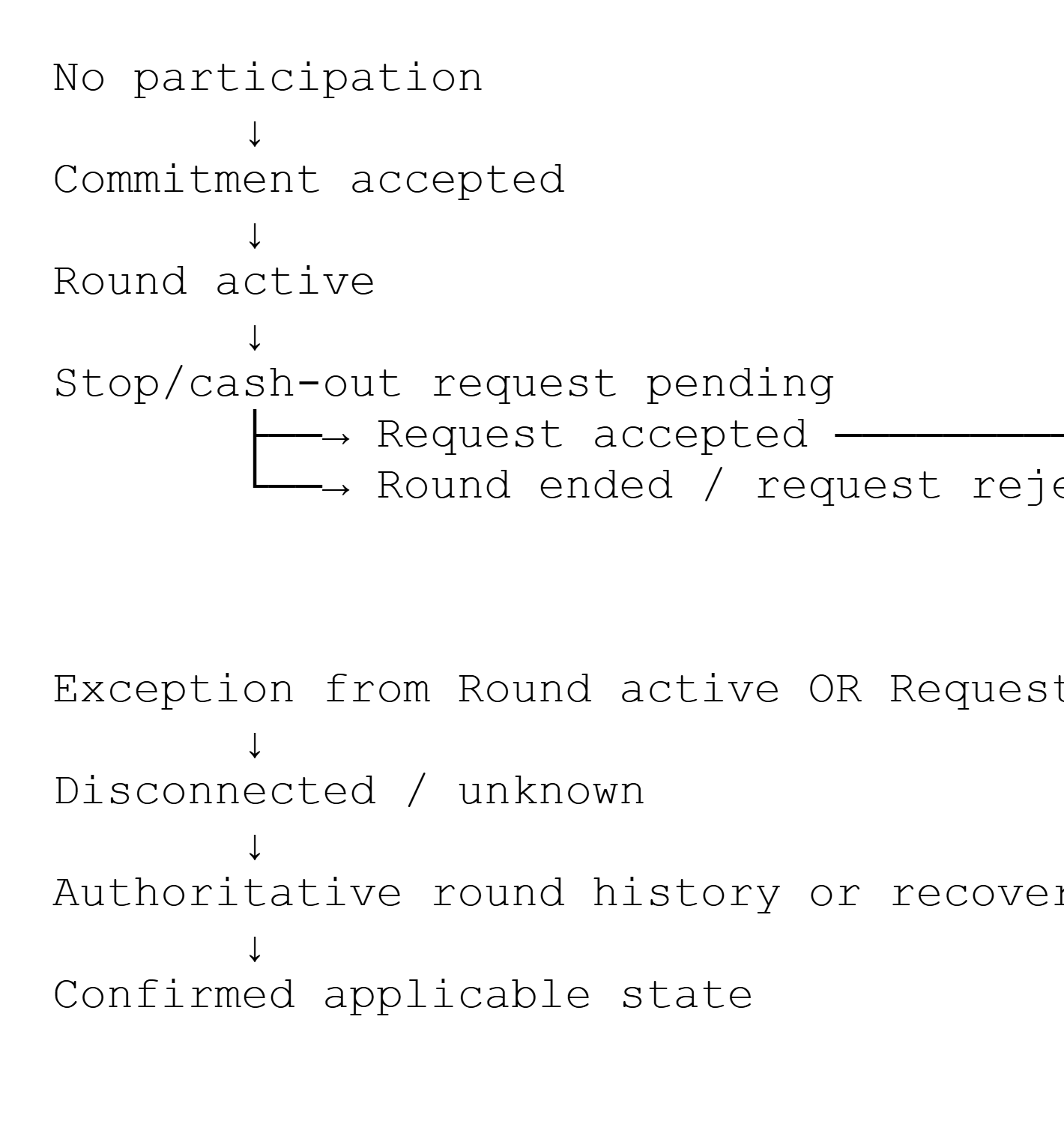
Four events need separate wording:
- Exit future rounds
- Disable any scheduled participation in later rounds. This does not undo an accepted commitment in the current round.
- Request a permitted action
- In this concept,
Request cash-out
identifies the action allowed by the current rules and availability state. It requests an action rather than guaranteeing its completion. - Submit the request
- Activating the authenticated control sends the request and enters
Request pending
. A submission acknowledgment confirms receipt only. Acceptance requires a separate game acknowledgment. - Confirm the result
- The game records the settled outcome for the identified round and participant. Request acceptance alone does not establish that a balance update or transfer has completed.
| State | Visible information | Available control |
|---|---|---|
| No participation | No current commitment, future participation status, rules and interruption policy. | Leave or disable future participation. A separate explicit commitment action. |
| Commitment accepted | Confirmed amount, token unit, round identifier. | Exit future rounds. Current-round actions follow the disclosed rules. |
| Round active | Current state, graph, request availability. | Authenticated Request cash-outwhile this fixture marks it available. |
| Request pending | Submission receipt and request identifier. Acceptance remains unconfirmed. | Inspect request status and exit future rounds. Duplicate submission is unavailable in this concept. |
| Request accepted | Game acknowledgment tied to the request and round. | View acknowledgment while awaiting settlement. |
| Round ended / request rejected | End state and authoritative rejection reason, when supplied. | View history and the applicable rules. |
| Settled result | Confirmed game outcome, with balance status shown separately. | View result details or leave. |
| Disconnected / unknown | Status unknown, last confirmed state, round and request identifiers. |
Reconnect, open authoritative round history, or follow the stated recovery process. |
Three paths through the labels
- Leave before the next commitment. With no current commitment, selecting
Exit future rounds
leads to confirmation that future participation is off. Leaving the screen alone does not establish that status. - Submit an available request. An authenticated participant presses
Request cash-out
while the fixture says it is available. The label changes toRequest pending
. The interface waits for game acceptance or rejection. Availability at activation cannot guarantee acceptance when the request reaches the game. - Disconnect after submission. The display changes to
Status unknown
. Authoritative round history identifies the request and its recorded disposition. If history cannot resolve it, the disclosed recovery process remains available. Disconnection establishes neither success nor failure.
The companion fixture verifies these labels and routes in a browser. A keyboard walkthrough reaches the named stop control while the sample round is active. Enter produces the pending label and disables a duplicate action. Recovery and network behavior need separate verification in an implemented product.
Stop and exit controls need understandable names, keyboard access, visible focus, and status announcements for assistive technology. Pending and unknown states need text beyond color or animation. These features make permitted actions accessible without promising that every product offers the same action or a refund.
A token result needs its own confirmation
Suppose the fictional commitment is 10 DEMO, with DEMO explicitly labeled as a fictional token unit. After the round ends and a request is rejected, the settled record reads Game result confirmed: 0 DEMO returned from 10 DEMO committed
. The full 10 DEMO was lost.
A separate label can read Balance synchronization pending
. Game confirmation and balance processing are distinct events. This screen establishes no blockchain transfer, and settlement does not imply that every result is recorded on-chain.
Standards and the broader audit
The UK Gambling Commission standards provide external benchmarks for this US-focused review within their documented Great Britain remote gambling scope.
- RTS 3 addresses rules available before commitment and clear outcomes. RTS 3B covers applicable current-state information, while 3C addresses likelihood information.
- RTS 10 addresses fair interruption handling and understandable advance policy information. Recovery depends on the stage and product.
- RTS 14 addresses active encouragement to continue after choosing to stop under 14A. Within its casino scope, 14F prohibits celebrating returns at or below the total stake.
This state review feeds a casino interface transparency audit covering rules disclosure, accessibility, interruption recovery, result history, and balance reconciliation. Those checks require evidence beyond the schematic.